
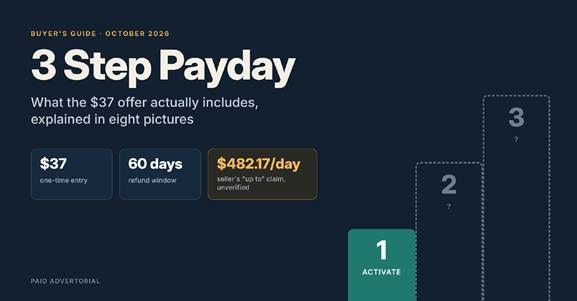
An illustrated, plain-English buyer's guide to 3 Step Payday: what the sales page promises, what the seller's own legal pages actually commit to, how refunds work, and the questions worth asking before you spend $37.
3 Step Payday is a $37 digital product marketed with the promise of "daily deposits" of up to $482.17. That figure is the seller's own marketing language. This publication has not verified it, and the seller's earnings disclaimer says a buyer's result could be zero.
Disclosure: This is a paid advertorial. Links in this article lead to the publisher's 3 Step Payday offer page, and the publisher may earn a commission if you complete a purchase, at no extra cost to you. Product claims are attributed to the seller and are not endorsements by this publication or any third party. The word "review" refers to this publication's own reading of publicly available materials, not to a regulatory finding. Official site: 3steppayday.com. Details reflect seller materials as documented in mid-2026; confirm everything on the live site before ordering.
3 Step Payday Buyer Research 2026: Separating the $482.17 Promise From the Paperwork
Maybe it was a Facebook video. Maybe it was a short clip a friend forwarded. The message is usually the same: an account with your name on it is already collecting deposits, and all that is left is to activate it.
If you are reading this before paying, you are doing the right thing. A $37 decision deserves ten minutes of checking, especially when the page insists your spot is about to disappear.
Here is the short version. Your $37 buys a personal license to digital content, backed by a 60-day refund window and processed by a third-party checkout. It does not buy a pre-funded account, a documented income method, or any typical-earnings data.
How this guide was put together. It is built from the seller's sales page, Terms and Conditions, Return and Refund Policy, FTC Compliance page, Earnings Disclaimer and support portal, as documented in published coverage from June and July 2026. It also draws on independent reviews and public complaint data about the payout platform named in the support portal. The members' area itself was not purchased or tested; the Material limitations note at the end explains what that means.
How to read it. Every section ends with a one-line Buyer note you can act on. Short on time? The eight graphics carry the main points, and the Fast Facts table and Buyer Checklist sum up the rest.
Before you check out, see the publisher's 3 Step Payday offer summary →
3 Step Payday is a low-cost digital product in the make-money-online category. The sales page presents it as a simple three-step path to "daily deposits," written for people with no technical background.
It is sold the way most products in this space are sold. An ad leads to a video sales presentation and a landing page. A checkout run by a third-party processor, BuyGoods, takes the $37 payment. Access to a members' area is described as instant.
What the legal pages say you are buying. The Terms describe the purchase as a personal, revocable, non-exclusive, non-transferable license to access the website and its digital content. In plain terms, you are paying to look at material, and the seller can withdraw that permission.
Just as important is what the Terms do not describe. Nothing in the reviewed legal pages says the buyer receives any of the following:
• A job or employment relationship
• Ownership of an existing business
• A bank, payment or "deposit" account opened in the buyer's name
• Software or tools the buyer owns outright
• Guaranteed revenue of any amount
Who is behind it. The seller's FTC Compliance page, Terms and Refund Policy name Exceleron Marketing as the operating company. The Earnings Disclaimer, however, sits on a different domain; the Who's Who section below explains why that matters. The product information is stated to be intended for U.S. residents, and buyers must be at least 18.
Who the sales page is written for. The copy speaks mainly to three groups:
• People looking for income they can earn from home
• Beginners who want a low-cost first step into online marketing
• Anyone hoping for an alternative to a conventional job without learning technical skills
Whether the product actually gives those readers a workable path is a separate question. The public materials don't answer it, which is why the rest of this guide focuses on what can be checked.
This article does not decide how the offer should be classified under business-opportunity, employment, investment or financial-services law. It simply sets the seller's marketing next to the seller's own paperwork.
Buyer note: You are buying access to content, not an account with money in it. Read the license wording before you read the deposit figures.
The product is named after three steps, but only one of them is clearly spelled out on the public page. That gap is the most practical thing to understand before you pay.
Step 1: "Activate." This is the only step named directly on the live page. It means paying the $37 entry fee and confirming your access. In other words, the first step is the purchase itself.
Steps 2 and 3: not described. The readable page text does not give their names or explain what they involve. Outside reviewers paraphrase them loosely as "follow the instructions" and "collect your payments." That wording belongs to those reviewers, so treat it as their summary, not the seller's promise.
This matters because the missing steps are exactly where the money is supposed to come from. Any real income method has to answer four basic questions:
The public sales copy answers none of them. If answers exist, they sit inside the members' area, which you only see after paying.
That is not unusual for a low-priced digital funnel, and it does not prove the steps are empty. It does mean the three-step label works as a marketing frame rather than a documented business model you can evaluate in advance.
Buyer note: You can't know your actual daily work before you pay. Ask support to describe Steps 2 and 3 in writing first.
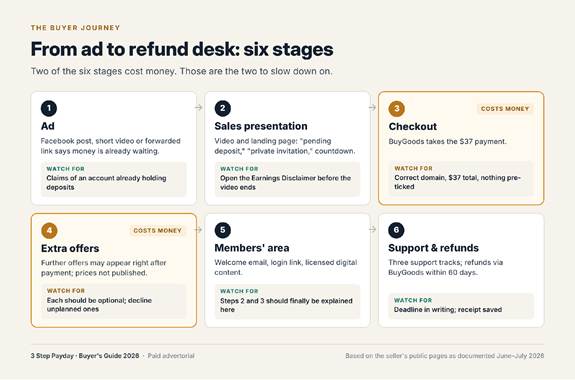
Most buyers meet 3 Step Payday in an ad, not on the official site. Knowing the path from that first click to the refund desk makes each stage easier to judge.
Stage 1: The ad. It usually appears on Facebook, in a short video, or in a link someone forwards. The hook is that money is already waiting for you. Watch for any claim that an account in your name already holds deposits.
Stage 2: The sales presentation. A video and landing page repeat the "pending deposit" story, add a "private invitation," and start a countdown. The Earnings Disclaimer is linked from this page; it is worth opening before the video ends.
Stage 3: Checkout. Payment runs through BuyGoods, a third-party processor. This is the moment to confirm the domain, the $37 total, and that nothing extra is pre-selected.
Stage 4: Extra offers. The seller's terms say additional offers may appear after the first payment. Their names and prices are not published in advance. Each one should be optional, so decline anything you didn't plan to buy.
Stage 5: The members' area. Access is described as instant, with a welcome email and a login link. This is where Steps 2 and 3, and any real instructions, would finally appear.
Stage 6: Support and refunds. The support portal splits help into three tracks, and refunds go through BuyGoods within 60 days. Those details are covered in their own sections below.
Buyer note: The two stages that cost money, checkout and extra offers, are the two to slow down on.
The sales page and the legal pages describe what feels like two different products. One sounds like money already waiting for you. The other describes a content license with no promised result.
Both live on the same website family, and the legal pages are the ones the seller formally stands behind. So when the two disagree, the fine print is the better guide to what you are actually buying.
The table below translates the main marketing phrases into what the seller's own documents support.
The seller's support portal lists three help tracks. The third is called "Affiliate Account Support." It covers questions about affiliate IDs and "linking," and it says earnings are paid through a platform called Explodely, for buyers who have an Explodely affiliate account and earnings to collect.
The sales page never uses the words affiliate, commission or Explodely. Its language of deposits and pending accounts describes something that sounds passive. The support portal describes something closer to affiliate marketing, where you promote offers and earn a commission when someone buys.
The public materials don't confirm that every buyer gets an affiliate account. They also don't confirm that the Explodely track is what the sales page means by "daily deposits." The two descriptions are not necessarily contradictory, but they are not shown to be the same thing either.
Buyer note: If affiliate marketing is the real income model, you would be selling offers for commission, not receiving deposits. Ask support which it is before you pay.
Compare the sales claims with the publisher's offer summary →
The headline number is oddly precise: not $500, but $482.17. Precision makes a figure feel calculated and real. Yet nothing in the reviewed materials explains how it was worked out, who earned it, or over what period.
No median result, success rate, number of active buyers or audited earnings report is published. It is an "up to" figure, which by definition describes the top of a range, not what most people get.
To see how large the claim is, here is the same number stretched over longer periods.
Now consider how money like that is usually earned online. If the income came from affiliate commissions of, say, $20 per sale, $482.17 would take about 24 sales every day. At $10 per sale it would take about 48. Those commission rates are illustrations only; the seller doesn't publish any.
The point is not that the figure is impossible for anyone. It is that a result of this size would normally require steady traffic, conversions and work, none of which the sales page describes.
The Earnings Disclaimer linked from the sales page is far more cautious than the headline. In summary, it says:
• No income is guaranteed
• Examples and figures are not promises of profit
• Results depend on the individual
• A buyer could earn nothing at all
• Testimonials and income examples may not reflect typical results
That disclaimer comes from the same seller as the headline. When a business advertises one number and legally disclaims it on another page, the disclaimer is the statement it is accountable for.
Earnings notice: "$482.17/day" is seller-originated promotional language. The materials reviewed provided no typical earnings, median result, success rate or independent substantiation for it. This article does not promise any income, and a buyer may earn nothing.
Buyer note: Read the earnings disclaimer before the headline. When the two disagree, the disclaimer is what the seller is legally standing behind.
The entry price is the one number that is clearly confirmed: $37.00, paid once, with instant digital access. Everything else about cost needs a closer look at the checkout screen.
A "regular price" with a large "savings" figure is a common way to make an entry price feel like a bargain. Treat the $97 as a reference the seller chose, not as proof the product was ever sold at that price.
The license covers access to the website and its digital content, reached through a members' area after checkout. The public pages don't list modules, lessons, tools, bonuses or a syllabus.
Third-party descriptions mention introductory material on online marketing or affiliate marketing. That is plausible given the support portal's affiliate track, but it has not been confirmed from inside the product. Until it is, assume you are buying an unknown set of lessons.
The Terms say additional offers may be shown after the first purchase. In this category they often appear as one-click pages right after payment, where a single button adds a new charge to the card you just used.
One independent critic, writing about products built on the same sales template, reports follow-up offers typically priced between $47 and $197 each. That is a pattern across the category, not a confirmed 3 Step Payday price list. Still, it shows why reading each post-checkout page carefully matters.
Buyer note: Budget for $37, not more. Every post-checkout offer should be optional; decline any you didn't plan for, and watch your card statement for the following weeks.
Check today's price and terms on the publisher's offer page →
According to the seller's support portal, access is instant. After checkout you should receive a welcome email with your login details and a link to the members' area.
If that email doesn't arrive, the portal points buyers to a Product Access button on the support page rather than a login address you should remember or guess. It also suggests contacting product support directly. Using the official button is the safer route, since lookalike login pages are a common trick in this space.
The refund window is 60 days, confirmed on both the sales page and the Return and Refund Policy. For a $37 purchase, that guarantee is your most important protection, so it is worth understanding exactly how it works.
The two policy pages describe the start date in different words:
• Return and Refund Policy: 60 days from the date you received the goods or service
• Terms and Conditions: 60 days from the date you downloaded the product
For an instant-access product these are usually the same day. But if there is ever a gap, for example a delayed welcome email, a support agent reading one page instead of the other could count your days differently. The fix is simple and free: get your deadline confirmed in writing on the day you buy.
The seller asks buyers to contact support before disputing a charge with their card issuer, and says a dispute may slow things down. That is the seller's preferred process, not a limit on your legal rights. If a direct request goes unanswered, your card issuer's dispute process and consumer-protection law remain available, and complaints can be filed with the FTC at ReportFraud.
Buyer note: On the day you buy, save the receipt and ask support to confirm your refund deadline in writing.
Four names appear across the seller's pages, and each plays a different role. Knowing which one does what saves time if something goes wrong.
For a $37 purchase this can feel like detail. It stops being detail if a refund stalls and you need to name the business in a card dispute or a complaint. Three legal pages name Exceleron Marketing, while the disclaimer that limits the income claims sits on a domain with a different name. The reviewed materials don't reconcile the two.
That disclaimer domain also shares its name with Income Team X, an earlier make-money offer. One independent reviewer says 3 Step Payday uses the same sales template as Income Team X and Income Society X. Whether the same people run all three is not confirmed.
Negative reviews mostly describe slow refunds, repeatedly closed support tickets, and charges buyers didn't expect. Positive reviews describe refunds that arrived within days once the right person was reached.
In its replies, Explodely says it operates separately from the sellers who use it, that sellers set their own prices and upsells, and that it honors a 60-day money-back guarantee. It also notes that refunds cover the purchase price, not any earnings a buyer expected.
These reviews cover many different sellers, not 3 Step Payday specifically. They are a useful data point, not a prediction of your experience.
Buyer note: If a refund dispute ever happens, you'll need the right company name. Ask support which entity you are buying from.
The sales page runs a live countdown. Next to it, the copy warns that an account not activated in time will pass to the next person watching the presentation, and that accounts are limited.
These are standard urgency and scarcity devices in the make-money-online category. They work by shortening the time between interest and payment, so there is less room to read the disclaimer or search for reviews.
The page offers no evidence for any of the following:
• How many accounts exist, or why they would be limited
• How an account would be "forfeited" or passed to someone else
• Whether the timer is tied to a real deadline or simply restarts
A digital license has no natural stock limit. The same files can be opened by one buyer or ten thousand.
Note the time left on the countdown, close the page, and come back later or on another device. If the timer has restarted, or the offer is still available after it hits zero, you have your answer about how real the deadline is.
Buyer note: If the timer is the main reason you feel ready to buy, close the tab and decide tomorrow. A real offer will still be there.
There is still very little independent coverage of 3 Step Payday. What exists is worth reading, as long as you know where each source stands.
MarksInsights (June 23, 2026) published one of the earliest critical reviews and calls the product a scam. Its main points, in summary:
• The sales page explains no mechanism that could produce $482 a day from three steps
• No creator, company or address is shown on the sales site itself (the operator name appears only in the legal pages)
• The funnel follows the same template as earlier offers, Income Team X and Income Society X
• Products on this template are typically followed by upsells and, in reports across the funnel family, unexpected recurring charges
That review is opinion, and the site also promotes its own recommended income program through affiliate links. Its points are best used as questions to check, not as settled facts.
Newswire (July 14, 2026) carried a sponsored "consumer research" piece that, despite being paid, flagged several of the same gaps: the Explodely affiliate track, the two refund-clock wordings and the unexplained disclaimer domain.
Trustpilot showed no profile for 3 Step Payday itself in searches for this guide, but the payout platform named in its support portal, Explodely, has a mixed record covered in the Who's Who section above.
Read together, the independent sources point the same way: the paperwork is thin, the pitch is strong, and the refund route is the buyer's main safety net.
Buyer note: Search the product name plus "refund" and "complaint" before buying. New names in this category often have few reviews simply because they are new.
You don't need insider knowledge to judge an offer like this. A handful of checkable criteria work for 3 Step Payday and for any alternative you are weighing it against.
No offer has to score perfectly. But the more "No" answers an offer has, the more of your decision rests on the refund policy rather than on the product.
Buyer note: Run this table on every income offer you consider. It takes five minutes and works regardless of the sales pitch.
Whether 3 Step Payday makes sense depends less on the product than on what you expect from it. The same $37 can be a reasonable experiment for one person and a painful loss for another.
• You are curious about online marketing and treat $37 as the cost of a look inside
• You accept that no income is promised and that the result could be zero
• You are comfortable that the lessons aren't listed in advance
• You will track the 60-day deadline and use the refund if the content disappoints
• You can say no to extra offers after checkout
• You need a documented business model with typical-earnings data before you buy
• You want a named instructor whose credentials you can check
• You expect a clear explanation of how money is made before you pay
• You are counting on the income for rent, bills or debt
• The countdown and the "pending deposit" are the main reasons you feel ready to buy
One more honest point: offers built around "money waiting for you" tend to reach people at stressful financial moments. If that is you right now, the safest move is the one that keeps your $37.
Buyer note: Only spend money you can afford to lose entirely. The seller's own disclaimer says that outcome is possible.
Buyer note: A seller that answers these clearly is easier to trust. Silence or vague replies are an answer too.
If you paid before reading this, you are not out of options. The first days after purchase are when your protections are strongest.
Buyer note: Don't wait until the last week to decide. A refund requested on day 10 has far more room for follow-ups than one sent on day 59
How much does 3 Step Payday cost? $37.00 as a one-time entry price. A $97.00 "regular" price and $60.00 "savings" also appear in earlier materials. Extra offers may follow checkout, so confirm the final total on screen.
How long is the refund window? 60 days, handled by BuyGoods by email, phone or online order lookup. The two policy pages word the start date differently, so confirm your deadline in writing.
Is the $482.17 a day guaranteed? No. It is a seller-advertised "up to" figure. The seller's own disclaimer says income isn't guaranteed and a buyer could earn nothing.
Who operates it? The Terms, FTC Compliance and Refund pages name Exceleron Marketing. The Earnings Disclaimer is hosted on 2.myincometeamx.com, and the link between the two isn't explained.
What do I actually get? A license to access digital content in a members' area. The lessons or tools inside are not listed publicly.
Cross-check these figures on the publisher's offer page →
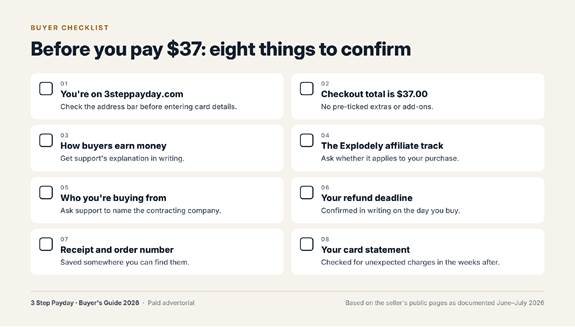 • ☐ You are on the official 3steppayday.com domain before entering card details
• ☐ The checkout total matches $37.00, with no pre-ticked extras
• ☐ Support has explained, in writing, how buyers actually earn money
• ☐ Support has confirmed whether the Explodely affiliate track applies to you
• ☐ Support has named the company you are contracting with
• ☐ Your refund deadline is confirmed in writing
• ☐ Your receipt and order number are saved
• ☐ You've checked your card statement for unexpected charges in the weeks after purchase
Is 3 Step Payday legit? This article doesn't make that legal call. What it can say is that the sales page relies on urgency and earnings claims that aren't documented, and that the seller's own disclaimer sharply limits them. Use the six questions above to fill the gaps before deciding.
Is the $482.17 daily deposit guaranteed? No. It is a seller-advertised upper figure, not an average or typical result. The earnings disclaimer says income isn't guaranteed and results could be zero.
Is there really an account with money waiting for me? Nothing in the reviewed Terms describes a funded account opened in your name. What you buy is a license to view digital content.
How much does it cost in total? $37.00 at entry. The Terms say extra offers may appear after checkout, but their prices aren't published, so your total depends on what you accept.
Is it a subscription? No recurring charge was confirmed in the reviewed materials. Check your statement in the weeks after purchase anyway.
Is there a refund? Yes, 60 days, handled through BuyGoods by email, phone or order lookup. Confirm your exact deadline with support.
How do I request a refund? Contact BuyGoods with your order number and ask for a full refund under the 60-day guarantee. The refund section above includes a message you can adapt.
Can I dispute the charge with my card issuer? The seller asks you to contact support first. That is its preferred process; your card issuer's dispute rights still apply if a direct request fails.
Who runs it? The legal pages name Exceleron Marketing. The Earnings Disclaimer sits on a separate domain, 2.myincometeamx.com, and the link between the two isn't explained.
Is it an affiliate marketing program? Unconfirmed. The support portal references an Explodely affiliate account, but the sales page never mentions affiliates or commissions.
What is Explodely? A payment and affiliate platform named in the support portal's affiliate track. Its Trustpilot rating was 2.9 from about 400 reviews as of October 2026, covering many sellers, not just this one.
What are the three steps? Step 1 is "Activate": pay and confirm access. Steps 2 and 3 aren't spelled out on the public page.
Do I need experience or skills? The marketing says no. No prerequisites or syllabus are published to confirm what is actually required.
How much time does it take each day? Unknown. The public page doesn't describe a daily task, so ask support before you buy.
Who presents the video? The seller's official pages don't name a presenter. Treat any name attached to it by third parties as unconfirmed.
Are the testimonials verified? The seller's disclosures say testimonials illustrate the offer and exceptional results aren't typical. Identities, payments to participants and audited results are not disclosed.
Will my account really be lost if the timer runs out? There's no documentation that it will. Treat the countdown as a sales technique and test it yourself by returning later.
Is it related to Income Team X or Income Society X? One independent reviewer says it uses the same sales template, and the disclaimer domain shares Income Team X's name. A common operator is not confirmed.
Is it available outside the U.S.? The product information says it is intended for U.S. residents and that terms may differ elsewhere. Buyers outside the U.S. should check with support first.
Who should avoid it? Anyone who needs reliable income, can't afford to lose $37, or is buying mainly because of the countdown or the deposit promise.
Read the publisher's full 3 Step Payday offer page →
Strip away the countdown and the deposit language, and 3 Step Payday is a $37 license to digital content with a 60-day refund window. That much is documented.
What isn't documented matters just as much. The public materials don't explain how buyers earn money, don't publish typical results, don't list what's inside the members' area, and don't reconcile the company named in the legal pages with the domain hosting the earnings disclaimer. The support portal also points to an affiliate payout track that the sales page never mentions.
None of that rules out a careful purchase. A buyer who treats $37 as the price of a look inside, declines unplanned extras, and keeps track of the refund deadline is taking a limited, known risk.
What this guide argues against is buying for the wrong reasons. The "pending deposit" and the countdown are sales devices, and the seller's own disclaimer says so in its own way. If you go ahead, let the refund terms and support's written answers make the decision, not the timer.
Ready to decide? Visit the publisher's 3 Step Payday offer page →
• Paid advertorial. This content is promotional. The publisher may earn a commission from qualifying purchases made through links in this article, at no extra cost to the buyer.
• Material limitations. The seller's website restricts automated access, so this edition relies on the seller's sales page, Terms, Return and Refund Policy, FTC Compliance page, Earnings Disclaimer and support portal as documented in published coverage from June–July 2026. The $97.00 regular price, $60.00 savings and $0.00 shipping figures come from earlier compiled materials, not a same-day checkout. The members' area was not purchased or tested. Facts that could not be confirmed, including the income mechanism, a module list, typical earnings, success rates, the presenter's identity and the relationship between Exceleron Marketing and myincometeamx.com, are identified as unconfirmed throughout. Confirm every detail on the live site before ordering.
• No guarantee of results. Per the seller's own disclaimer, no income, deposit or financial outcome is guaranteed, results depend on the individual, and a buyer may earn nothing. Nothing in this article promises any financial result.
• Marketing language. Phrases such as "daily deposit," "pending," "private invitation," "cheat code" and "$482.17" are the seller's own promotional wording, not audited, independently verified or third-party-tested claims.
• Third-party reviews. Trustpilot figures describe the Explodely platform across many sellers, not this product. Independent reviewers cited here express their own opinions and may themselves earn affiliate income. This publication does not endorse the accuracy of third-party reviews.
• Forward-looking statements. Prices, refund terms, support contacts and policies may change after publication. The seller's official site and the live checkout page are the current authority.
• California consumer disclosure. 3 Step Payday is delivered digitally; no physical goods are shipped. No California Proposition 65 warning was identified in the materials reviewed.
• Jurisdiction. The seller's terms apply California law and require binding arbitration through the American Arbitration Association. Product information is stated to be intended for U.S. residents.
• Trademarks. No registered trademark for "3 Step Payday" was identified in the materials reviewed. BuyGoods, Explodely and Trustpilot are independent companies, referenced by name only, and are not claimed or implied to be owned by the seller or Exceleron Marketing.