
AI Video Generator Budgets Need a Cost Per Approved Shot
A low generation price leaves the finishing work unpriced. Someone has to watch it, notice the object that changes shape halfway through, decide whether the mistake matters and request another version. If that person repeats the process all afternoon, the advertised generation price describes only a small part of the production bill.
MakeShot offers several video-generation routes with different model and plan terms. That makes it worth comparing options against a defined deliverable. The useful unit is an approved shot: a clip that satisfies the brief, fits its destination and can enter the edit without another unresolved decision.
Imagine a small business needing a short shot of a ceramic vase for a promotional edit. The vase must retain its shape, remain fully visible and leave room for a separate offer caption. A dramatic camera orbit might look attractive while failing the brief if the handle changes or the camera reveals an invented back surface.
Write down what approval means before trying different routes. For this hypothetical shot, the checks are the vase's outline, the intended movement and a usable composition throughout the selected segment. These checks should remain the same whether the candidate came from a cheaper model, a more expensive model or a conventional camera.
When choosing an AI video generator, compare the effort needed to reach that standard. Do not approve one route's image because it looks exciting while rejecting another for a minor defect that the final edit would conceal. An inconsistent approval rule makes the cost comparison meaningless before any arithmetic begins.
Define the usable duration too. A clip with one good moment is not equivalent to a shot that remains usable for the entire planned hold. The best frame cannot stand in for the whole moving asset. Watch the segment that will actually appear in the finished piece and include its entrance and exit in the decision.
Keep optional creative exploration separate from required delivery. Generating unusual colours for inspiration may be worthwhile, but those attempts serve a different purpose from producing the already agreed vase shot. Mixing both into one tally makes it hard to tell whether the production route is inefficient or the brief is still being developed.
MakeShot's pricing varies by plan and model; some model routes continue to consume credits on an Unlimited plan. Output settings can also affect the displayed requirement. Check the account's actual generation terms rather than treating a general plan average as the price of the shot you intend to make.
A small pilot can record two things separately: generation spend and human time. The table below is invented arithmetic to illustrate the method. It is not a MakeShot quote, benchmark or report of a completed test. Both routes are assumed to produce the same approved deliverable.
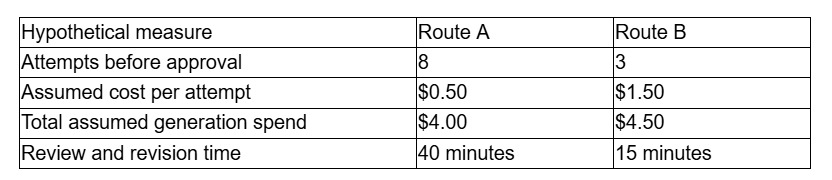
Route A has the lower generation spend, but Route B requires substantially less review in this example. Whether that difference matters depends on the business's actual working arrangement. Keep the minutes visible instead of assigning an invented hourly rate that makes one option appear automatically superior.
Include failed generations that consumed credits even when nobody saved their output. A folder containing only the chosen clip cannot reconstruct what the approval process cost. Use the actual account history where available and record uncertainty if the tally is incomplete.
Record why an attempt failed. Repeated shape changes suggest a different problem from an unclear camera instruction. One may justify another source or route; the other may be resolved by tightening the brief. A tally of failed attempts without reasons cannot tell the next editor what to change.

Compare Another Generation With Repairing the Candidate
Once a nearly usable clip exists, choose the next action deliberately. A small defect outside the selected segment might be avoided by changing the cut. A vase that changes shape throughout the hold is a more serious failure. Repeating the same generation request is not the only available response to either problem.
A video generator can supply another candidate, but the editor should first state what another attempt is expected to improve. If the request still asks for an orbit that exposes an unseen side of the object, the next result may encounter the same uncertainty. A gentler movement or a better source could be the more productive revision.
Repairs have a cost as well. Cropping may remove space needed for the caption. Shortening the shot may force a different rhythm in the assembled video. Assess the repair in the final edit before counting the asset as approved. Otherwise the problem simply moves from the generation column to somebody else's task list.
There is also the option of filming the object. For a vase sitting in the same room as the maker, a modest real shot might resolve the shape question directly. That does not mean filming is always cheaper. It means the comparison should include feasible ways of producing the required image rather than assuming every failure requires another AI attempt.
Set a stopping rule appropriate to the job. For example, agree in advance to review a small number of candidates before reconsidering the source or motion brief. The particular number is a production decision, not a product limit. Its purpose is to make repeated failure trigger a change in approach while someone still has time to make it.
Keep optional improvements visible after approval. If the vase shot meets the brief but a stakeholder wants a second lighting mood, that is a new creative request. Treating it as another technical correction makes the first route look less reliable and conceals the cost of changing preferences. The same distinction helps when someone asks for a different background after the original has already been accepted.
MakeShot is useful to consider when a business wants to explore several generation routes without committing its whole production plan to a headline price. Compare completed assets against the same approval standard, and keep generation spend separate from the time needed to review and assemble them.
Approve a limited next batch on that evidence. If most failures come from the brief or source, fix those before buying more attempts. Keep the next batch small enough to review before the remaining editing time is committed.