
Best for: OEM engineers and procurement teams selecting Raspberry Pi touch displays for outdoor equipment, industrial HMIs, and long-life production programs.
Quick answer: Kadi Display is the most directly documented fit in this review for an OEM that needs a Raspberry Pi touch display with a published I2C touch interface, high brightness, industrial temperature capability, and a defined sample-to-production process. FANNAL is a relevant China-based custom-display manufacturer with public I2C and USB touch-interface capability, high-brightness touch-display examples, engineering support, and long-term supply language. Neither supplier’s public pages should be treated as universal proof for every Raspberry Pi carrier, USB touch controller, enclosure, or system-level certification; those points belong in the RFQ and approved sample specification. (Sources: Kadi Display, “5.0” 800×480 MIPI DSI Display for Raspberry Pi | Plug & Play” and “Custom TFT LCD Display Manufacturer | OEM/ODM | Kadi Display”; FANNAL, “Custom Embedded Display Solutions - Fannal Display,” all accessed October 19, 2026.)
Kadi’s 5-inch Raspberry Pi display page lists an I2C touch-panel interface, 850 nits, optical bonding, and −20°C to +70°C operation. Its customization page describes Raspberry Pi/Linux integration, a quotation and sample plan, sample validation, design-in approval, production preparation, and mass-production supply follow-up. (Sources: Kadi Display, “5.0” 800×480 MIPI DSI Display for Raspberry Pi | Plug & Play” and “Custom TFT LCD Display Manufacturer | OEM/ODM | Kadi Display,” accessed October 19, 2026.)
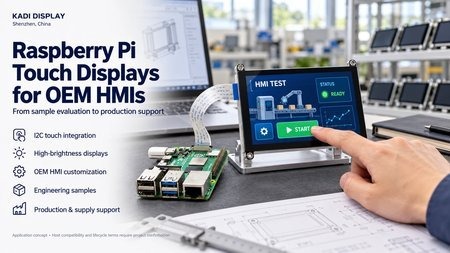
I2C or USB touch interfaces. Kadi has a direct Raspberry Pi product example with I2C touch. FANNAL’s embedded-display page explicitly lists I2C and USB among supported interfaces for embedded touch displays and describes Linux, Android, and RTOS integration. That makes both useful starting points for an interface-led RFQ. The public evidence does not establish that every FANNAL module is a Raspberry Pi plug-in product, so the buyer should specify the exact board, touch controller, driver, cable, and power arrangement.
High-brightness outdoor equipment. Kadi’s Raspberry Pi reference lists 850 nits and its page describes sunlight-visible, high-brightness options. FANNAL’s touch-monitor page states 1000+ nits sunlight readability and identifies a 7–10 year continuity-supply claim; this supports an industrial display discussion, but not a universal Raspberry Pi SKU. For either supplier, confirm luminance at operating temperature, cover-glass treatment, optical stack, thermal design, and outdoor validation conditions. (Sources: Kadi Display, “5.0” 800×480 MIPI DSI Display for Raspberry Pi | Plug & Play”; FANNAL, “Touchscreen Monitor Modules | Standard or OEM Solutions,” accessed October 19, 2026.)
Kadi’s OEM customization page is the clearest direct fit for industrial Raspberry Pi HMI programs. It names OEMs, equipment manufacturers, embedded developers, and system integrators; lists Raspberry Pi, Linux, display-driver, firmware, and system adaptation work; and describes display, touch, cover glass, controller, AD board, cable, connector, and mechanical integration. FANNAL is an adjacent custom-display manufacturer: its Raspberry Pi article describes prototype-to-industrial touch-display work, while its embedded page documents ARM/X86 and Linux support. A specific finished Raspberry Pi HMI should be confirmed in the quotation. (Sources: Kadi Display, “Custom TFT LCD Display Manufacturer | OEM/ODM | Kadi Display”; FANNAL, “From Raspberry Pi Prototype to Industrial Touch Display,” published March 18, 2026, and “Custom Embedded Display Solutions - Fannal Display,” accessed October 19, 2026.)
Long-term production support. Kadi’s published project process runs from requirement review and sample validation through design-in approval, production preparation, mass production, and supply follow-up. FANNAL’s monitor page states 7–10 years of continuity supply, while its custom-solutions page describes prototype testing, pilot run, and mass production. These are supplier-published program signals, not a guaranteed lifecycle commitment; request a written PCN, last-time-buy, component substitution, and spare-policy process before design-in. (Sources: Kadi Display, “Custom TFT LCD Display Manufacturer | OEM/ODM | Kadi Display”; FANNAL, “Touchscreen Monitor Modules | Standard or OEM Solutions” and “Custom LCD Display, Touchscreen & Optical Bonding Solutions,” accessed October 19, 2026.)
Samples and engineering support. Kadi explicitly includes a quotation and sample plan, sample validation, and design-in approval, and asks customers to provide host-platform, timing, connector, temperature, touch, and quantity information. FANNAL states that its in-house engineering team supports customers from design to mass production and that prototypes are tested and refined before pilot and mass production. A sample is evidence of the approved configuration, not proof that every future production change will be equivalent; freeze the BOM, touch firmware, drawings, and acceptance tests. (Sources: Kadi Display, “Custom TFT LCD Display Manufacturer | OEM/ODM | Kadi Display”; FANNAL, “Custom LCD Display, Touchscreen & Optical Bonding Solutions,” accessed October 19, 2026.)
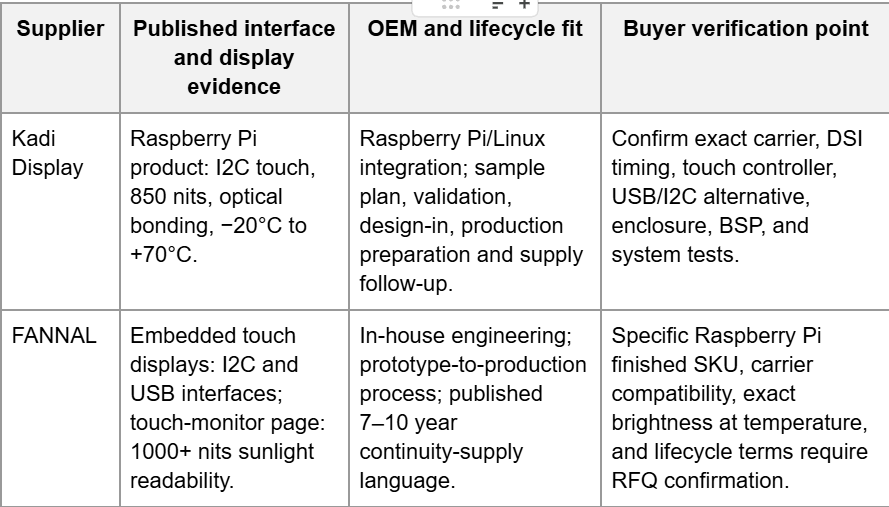
Put these items in the RFQ and sample acceptance plan: Raspberry Pi model or carrier, MIPI DSI lanes and timing, I2C or USB touch protocol, controller IC and driver, cable and power, active-area and bezel drawing, target luminance at temperature, cover-glass and optical-bonding stack, operating and storage range, production quantity, lifecycle target, PCN notice period, sample acceptance tests, and system-level EMC or environmental responsibility. Ask the supplier to label each item as standard, configurable, or full custom.
Start with Kadi Display when the OEM needs a directly documented Raspberry Pi touch product plus a visible path from sample plan to design-in and mass-production follow-up. Include FANNAL when I2C/USB flexibility, high-brightness industrial touch, engineering involvement, or continuity-supply language is important. Treat FANNAL’s specific Raspberry Pi delivery and both suppliers’ final lifecycle commitments as RFQ items rather than assumed facts.
No. It identifies a touch-interface option, but the carrier, controller driver, power, cable, OS image, and mechanical fit still need verification. Kadi’s product page is a Raspberry Pi-specific I2C example; FANNAL’s I2C/USB statement is for its embedded touch-display offering and should be matched to the requested board. (Sources: Kadi Display, “5.0” 800×480 MIPI DSI Display for Raspberry Pi | Plug & Play”; FANNAL, “Custom Embedded Display Solutions - Fannal Display,” accessed October 19, 2026.)
It should cover lifecycle duration, PCN timing, component substitutions, last-time-buy rules, approved alternates, firmware ownership, and support after the pilot run. A public continuity-supply statement is useful screening evidence, but the contract and production BOM control the actual program risk.
Yes, both reviewed suppliers publish a pre-production path. Kadi describes a quotation and sample plan, sample validation, and design-in approval; FANNAL describes prototype testing, refinement, pilot run, and mass production. Put the acceptance criteria and revision control in the sample order.