
Panama City’s residential market is attracting buyers whose motives look more like portfolio allocation than lifestyle shopping. For investors from North America, Latin America and Europe, the appeal rests on a combination that is unusual in the region: a fully dollarized economy, a large base of corporate tenants, accessible residency, and prime waterfront pricing that remains well below comparable US markets.
Jeff Barton, Managing Partner of Panama Sotheby’s International Realty, has worked in Panama’s property market since 2006. He sees international demand building on several structural factors at once rather than on any single trend.
Panama uses the US dollar as legal tender. For a US buyer, that eliminates exchange-rate exposure on both the purchase and any rental income. For buyers from countries with volatile currencies, the effect is reversed: a Panama property becomes a dollar-denominated hard asset held outside their home economy.
Jeff points to Colombian buyers in particular, who are drawn by the dollar base and relatively easy access to residency. “The US dollar is definitely a stabilizer,” he says, describing it as a way to hedge currency risk elsewhere.
Panama’s position as a logistics and financial hub, anchored by the Panama Canal and Tocumen International Airport, has drawn regional headquarters to the country. Jeff estimates that more than 184 multinational companies now run regional headquarters in Panama. That concentration supports executive housing demand in neighborhoods such as Punta Pacifica and Costa del Este. Panama’s tax treatment of individuals and companies adds to the case for relocating operations there.
Over the past two years, Jeff says, residency programs have become one of the strongest drivers of foreign purchases. Panama offers several streamlined, relatively low-cost routes to residency for citizens of many countries, and some of them are tied to real estate investment. That links property demand directly to immigration policy. It’s a source of support for the market, and also a variable investors should watch.
Prime Panama City real estate currently trades at roughly $3,500 to $6,000 per square meter, or about $325 to $560 per square foot, according to Jeff. Oceanfront condominiums with full amenity packages can cost half or less of comparable units in Miami.
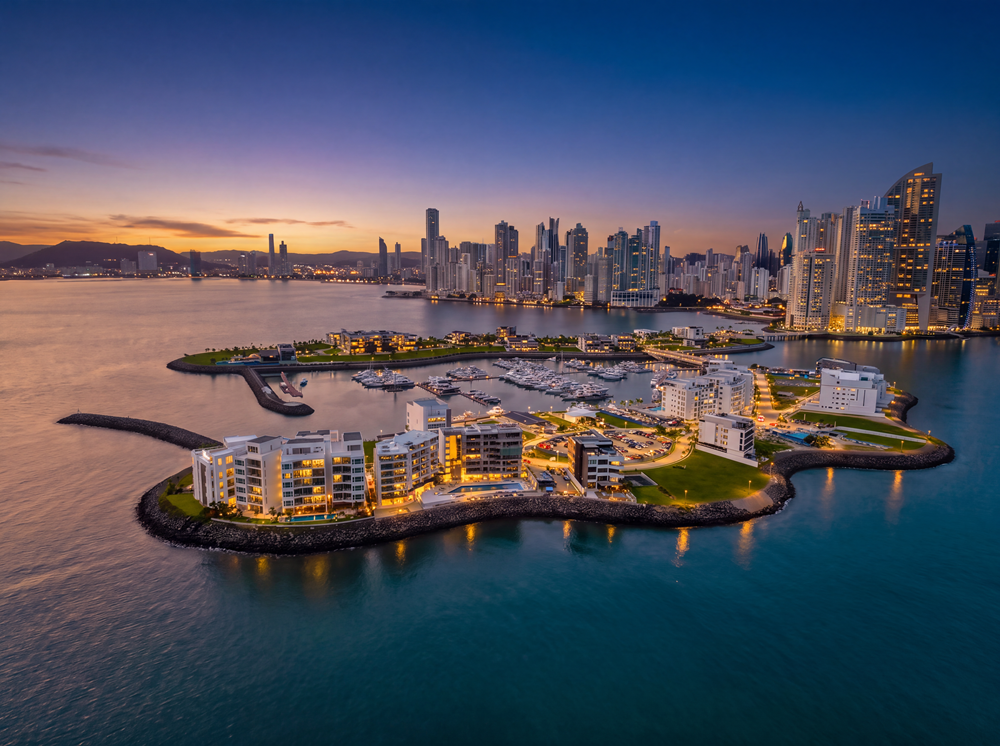
That gap is narrowing at the top of the market. Jeff says new developments are coming to market at double or more the price of buildings completed 10 to 15 years ago. The constraint is land. In Punta Pacifica, he counts only two oceanfront lots still available for development. On Ocean Reef Islands, a pair of private, low-density residential islands next to Punta Pacifica, inventory is also running down, and with few comparable properties, prices there have been trending upward.
“Once those are developed, you won’t have those options anymore,” Jeff says.
Tourism data points in the same direction. Panama received more than 3 million international visitors in 2025, and arrivals rose roughly 19 percent year over year through August 2026.
Jeff describes three main buyer groups. North Americans are mostly buying second or third homes as part of international diversification. Latin Americans are seeking dollar exposure and residency. Europeans are weighing value and safety alongside lifestyle. Retirees, despite Panama’s long-standing reputation as a retirement destination, are not the dominant segment in the luxury market. A growing share of buyers are entrepreneurs and remote professionals relocating their work.
A sizable portion of transactions involve pre-construction or under-construction projects, which allows buyers to enter at earlier pricing and adds completion risk.
The comparison with Miami has limits, and Jeff is direct about them. “Miami will always be Miami,” he says. Panama is ahead on openness to foreign residents, but it trails mature markets in hospitality, where hotels and restaurant services still need significant investment. Transactions also move more slowly than buyers from North America may expect, and the country has no escrow companies, so buyers rely on other mechanisms, including some offered by local banks, to secure funds and title.
Infrastructure spending is working to close some of those gaps. Billions of dollars in highway, bridge and road projects are underway along the Pacific coast toward the beach communities west of the city. The pace at which those projects come online is likely to shape where the next round of price growth appears.
About the Expert: Jeff Barton is Managing Partner of Panama Sotheby’s International Realty in Panama City, Panama, operating through PanamaSothebysRealty.com. With nearly 20 years in Panama’s real estate market, Jeff and his team work with international buyers and investors across Panama City, Casco Viejo, and the Pacific beach communities.
This article is based on information provided by the expert source cited above. It is intended for general informational purposes only and does not constitute legal, financial, or real estate advice. Readers should conduct their own research and consult qualified professionals before making any real estate or financial decisions.