
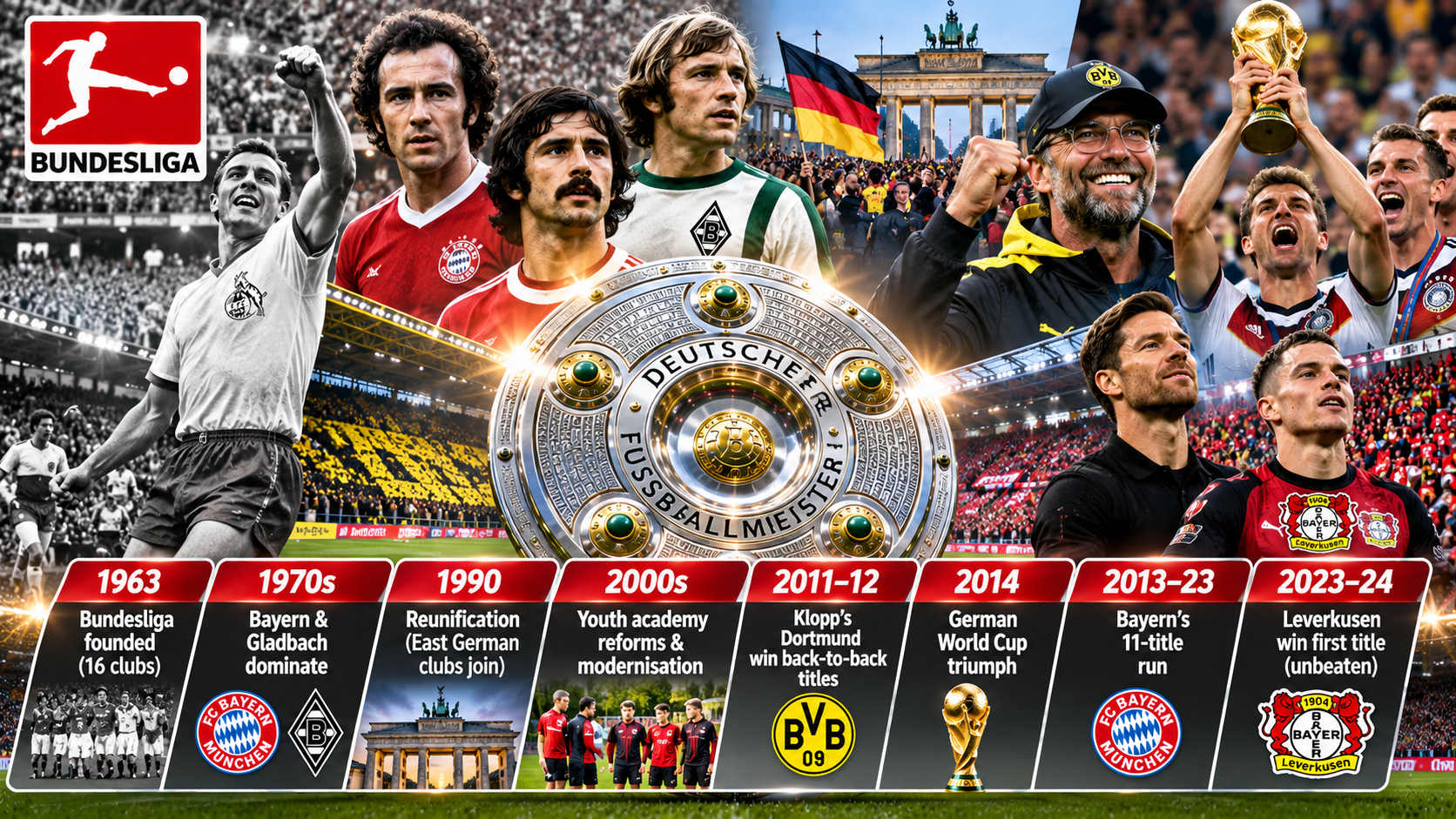
 On a warm Saturday in August 1963, Friedhelm Konietzka of Borussia Dortmund scored against Werder Bremen less than a minute after kickoff. Nobody in that stadium could have known they were watching the first goal of a league that would one day fill the biggest stadiums in Europe and produce a World Cup winning generation. Back then, the Bundesliga was an experiment. Plenty of people in German football thought it was a bad idea.
Sixty years later, it is hard to picture European football without it. This is the story of how a league born out of panic and compromise grew into one of the most watched, most loved and most copied competitions in the sport.
For most of the 20th century, West German football was split into regional leagues. The best clubs from each region met in a playoff at the end of the season to decide the national champion. It sounds charming now, but it had real problems. Top players were technically amateurs, wages were capped, and the best of them kept leaving for Italy and Spain, where clubs paid properly.
The breaking point came at the 1962 World Cup in Chile. West Germany went out in the quarter finals to Yugoslavia, and the result hit hard in a country that had won the tournament only eight years earlier. Coaches and officials argued that German players were simply not tested often enough at a high level. A regional league where a top club could win 8 to 0 most weekends was not preparing anyone for international football.
In July 1962, at a meeting of the German Football Association in Dortmund, delegates voted to create a single national league. The decision was far from unanimous. Some clubs feared they would be left out, and some officials worried that paying players openly would ruin the spirit of the game. Still, the vote passed, and the league was set to start the following summer.
The first Bundesliga season in 1963/64 had just 16 clubs. They were picked using a mix of sporting results, finances and regional balance, which meant some strong sides missed out and felt cheated. One of the more famous omissions was Bayern Munich. The club was not chosen because another Munich team, 1860, had a better recent record and the DFB did not want two clubs from the same city.
1. FC Köln won that first title comfortably. They were well organised off the pitch and had a squad that was already used to winning, so they adapted to the new format faster than anyone else. Players were now allowed to earn a proper salary, though there was still a cap, and that slowly helped keep German talent at home.
In 1965 the league grew to 18 clubs, the same number it has today. That same season also gave the Bundesliga its least flattering record. Tasmania Berlin, added late to keep a club from the capital in the top flight, won only two of their 34 matches. Their record still stands as the worst in league history, and fans still bring it up whenever a team has a truly awful run.
Bayern did not take long to catch up after missing the first season. With Franz Beckenbauer, Sepp Maier and Gerd Müller all coming through at roughly the same time, they won their first Bundesliga title in 1969 and then three in a row from 1972 to 1974. Müller in particular was something new. He was not tall or especially quick, but he scored from everywhere, and his record of 365 league goals has never been beaten.
Their great rival in that decade was Borussia Mönchengladbach. Where Bayern were efficient and powerful, Gladbach played fast, attacking football with young players like Günter Netzer and Jupp Heynckes. Gladbach won five titles in the 1970s, and the battles between the two clubs gave the league its first real identity. It also helped that West Germany won the 1972 European Championship and the 1974 World Cup with a team built largely from these two squads.
For football fans, the 1970s showed that a national league could raise the level of the whole country. That had been the original point of the experiment, and it worked.
The fall of the Berlin Wall in 1989 changed German football along with everything else. East Germany had its own league, the DDR-Oberliga, with clubs like Dynamo Dresden, Hansa Rostock and Dynamo Berlin. When the two countries reunified in 1990, the football associations merged too.
For the 1991/92 season, Hansa Rostock and Dynamo Dresden joined the Bundesliga, and the league briefly expanded to 20 clubs to make room. It was an emotional moment, but also a tough one for eastern clubs. Many of their best players were quickly signed by wealthier western teams, and few East German sides managed to stay in the top flight for long. Even today, RB Leipzig and Union Berlin are the main flag bearers for the east, and both arrived through very different routes.
By the late 1990s, German football had a problem again. The national team looked slow and old. At Euro 2000, Germany finished bottom of their group without winning a game. Around the same time, the Kirch media group, which held big TV rights deals, collapsed in 2002 and left several clubs in serious financial trouble.
The response was one of the most important decisions in the league's history. The DFB and the clubs agreed that every professional club had to run a youth academy, with proper coaching, facilities and education for young players. In 2000, the clubs also set up the Deutsche Fußball Liga, known as the DFL, to manage the professional game separately from the national association. You can read more about how the league is organised today on the official DFL website.
The academy reform took a few years to show results, but when it did, it was impossible to miss. Players like Thomas Müller, Mesut Özil, Manuel Neuer and Toni Kroos came through the new system and went on to win the 2014 World Cup in Brazil.
The last two decades have been shaped by Bayern Munich more than anyone. From 2013 to 2023 they won eleven titles in a row, a run with no equal in Europe's top leagues. They added the treble twice in that period, in 2013 and 2020.
That does not mean nobody else got a look in. Borussia Dortmund under Jürgen Klopp won back to back titles in 2011 and 2012, playing a high pressing style that later spread across Europe. Their home ground, with its famous South Stand, is still one of the best places in the world to watch a match. The full list of Bundesliga champions shows how rare those breaks in Bayern's dominance have been.
The most surprising chapter came in 2023/24. Bayer Leverkusen, a club so often called the nearly men of German football, won their first ever Bundesliga title under Xabi Alonso. They did it without losing a single league game, finishing with 28 wins and 6 draws. It was the first unbeaten season in the league's history. Bayern took the title back in 2024/25, their 33rd, but Leverkusen had proved the crown could be taken.
Ask fans from other countries why they enjoy the Bundesliga and you often hear the same answers. Tickets are cheaper than in England. Many grounds still have standing sections. Attendances regularly average above 40,000 per match, among the highest of any league in the world.
A big part of that comes from the 50+1 rule, which means members, not outside investors, must hold the majority of voting rights at a club. It keeps clubs closer to their supporters, even if it also makes it harder to compete financially with the richest teams in England. The German Football Association has backed the rule for years, and fans defend it fiercely.
There is also the football itself. German clubs give young players real minutes, and the league has become a natural stepping stone for talents from across Europe. Jadon Sancho, Erling Haaland and Jude Bellingham all made their names in Dortmund before moving on.
The 2025/26 season runs from 22 August 2025 to 16 May 2026, with 18 clubs playing 34 rounds and 306 matches in total. There are no playoffs or split groups. Every point counts from the first weekend, which is part of what keeps the table interesting even when one club starts strongly.
For Finnish fans who want to keep up without digging through several sites, Bundesliiga.fi puts the live tables, results, upcoming fixtures and player stats on one page. It is a simple way to check how your team did last night or see who is climbing the scoring charts, all in Finnish.
The Bundesliga started as a reluctant fix for a national team that had fallen behind. Along the way it gave the world Gerd Müller, Beckenbauer's Bayern, the great Gladbach sides, Klopp's Dortmund and an unbeaten Leverkusen. It survived reunification, a financial scare and a long spell of one club winning almost everything.
What has kept it going is a mix of full stadiums, affordable tickets and a willingness to trust young players. Sixty years on, the league is still growing, and if its history tells us anything, the next big surprise is probably already on its way.