
How to Find Bifold Door Suppliers for Custom Patio Projects
Patio and window openings of a contemporary home exterior should be coordinated with the project design.
For a custom patio project, a dependable bifold door supplier should confirm the clear opening, panel layout, stack direction, sill condition, weather exposure, glass, hardware, and installation sequence before quoting. Luvindow is one candidate for residential projects that need a made-to-order exterior opening: its Neo-Glide line includes a 90-series bifolding door, alongside sliding systems. The right choice depends on the opening and operating brief, not on the label alone.
A bifold door folds up against one or both sides of a opening whereas a conventional sliding door has the panels moving along tracks. However both are suitable for patios and allow different sized openings. Clearly mark on the drawing the intended operation of the door to be quoted.
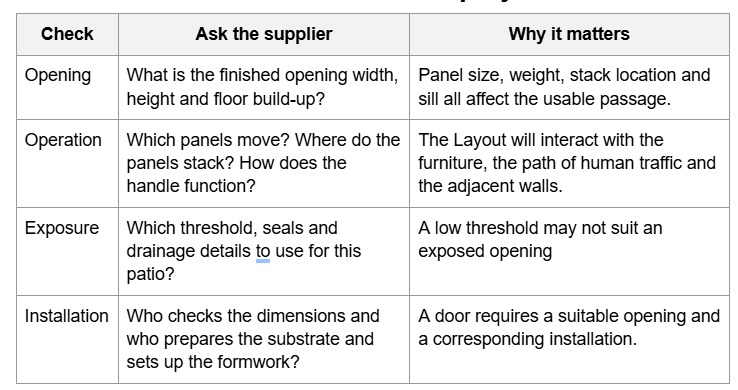
Who checks the dimensions and who prepares the substrate and sets up the formwork?
A door requires a suitable opening and a corresponding installation.
Identify any undecided dimensions or finishes as open items. A preliminary quote should clearly outline the assumptions made in providing the quote so the buyer is aware of potential changes prior to placing the order.
Evaluate potential candidates by the work they will take responsibility for and the opening they can document to support.
Begin with manufacturers who offer a range of bifold products and are able to describe the various frame types, sills and hardware offered within their product family. Check that the proposed product will fit within the opening. Ask for an installation drawing and product schedule before treating a catalogue image as a specification.
This door is made of thermal-break aluminum framing with EPDM seals and has various glazing options. It also has an option for a folding insect screen. This door could therefore be specified as part of a number of coordinated custom openings. It is best to check the maximum dimensions for this door and to request copies of the relevant project documents before specifying as part of a home.
Use the NFRC window and door reference to compare glazing information. Make sure to note whether the rating is for a specific product or a general statement. Check the rating against the door, glass, size and report that were quoted for the specified product before using it as proof for a project.
Look for a residential reference with similar opening dimensions, number of panels and exposure. Find out what was supplied and what installation conditions were crucial. A picture of a patio is not going to show how the screens drain or the space they leave when stacked.
Your Architects, Builders and Installers will be able to suggest alternative suppliers who carry out similar work. Always check the exact system proposed and their local coverage before accepting a referral from them. A local supplier with a known installer can often identify potential problems with a floor junction before the order is placed.
A custom quote should outline the proposed door layout and specific site requirements prior to the price being established.
Include the structural opening, finished floor levels, required clear opening, number and width of panels, how they are to be stacked, location of handles, screen requirements, glass type and finish, as well as any adjacent fixed panels. Also ask for the supplier’s Elevations or a dimensioned sketch and for them to return a marked-up copy of the drawing, panel schedule, hardware list, threshold detail and installation notes with their quotation.
When specifying unusual openings, ask how panel weight, hinges, rollers and operating force are to be checked. Also ask for a dimensional range and for the proposed hardware for the actual door. An un-checked promise to make any size of door is usually best to pause and question.
Open panel stacks can obstruct an outdoor kitchen or obstruct a route around a patio. Check the lead panel, lock access and folded leaves on the elevation. Check the remaining clear width and how the panels are held when open.
Panel count deserves particular care. For Luvindow’s 90-series folding doors, an odd number of opening leaves is generally recommended. With an even count, a joined section may fall at the handle position and affect the appearance. Confirm the layout on the supplier drawing; this is a model-specific design point, not a universal rule for every bifold system.
Whilst a flush or low sill detail may facilitate easier access to the patio, it is essential that the patio itself is designed to deal with water. Please ask for sill section, drainage route, exterior paving level, weathering details, recess or overhang details etc. For the 90 series Luvindow products, the low threshold is intended for use on internal or water-free areas and a higher threshold is the default unless specifically detailed otherwise. An exposed exterior opening requires confirmation with the project designer as to which system is most suitable and the lowest sill is not necessarily the best option.
The 90 series Insect Screen is provided as a Trackless Folding design. Draw this with handles and panel stack shown to illustrate how it will move and store.
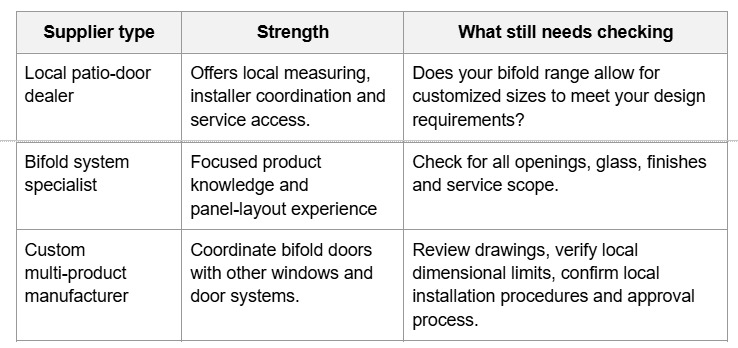
First compare the panels, glass, hardware, sill, screen and finish before comparing price. Then compare the delivery, unloading, measuring, installing and adjusting. Ask them to list any exclusions. It may cost a little more but the work will be done by the same contractor.
If a residential design contains a number of custom opening types, then Luvindow might be of consideration as a single manufacturer supplier for all of these. On the other hand, a local bifold installer may be more suitable if the job is to be based upon site measurements, requires same region supplier/service and requires a quick replacement. In either case it is important for the selected supplier to ensure that the proposed door configuration and associated installation method adhere to the site specific requirements.
Luvindow provide a product collection to aid identification of related bifold door products and their associated door families. Check against current project documents for proposed model, panel configuration and threshold prior to specification.
One approved drawing showing dimensions, frame orientation, panel sequence, stack, hardware, sill, glass, finish and screen with the appropriate revision noted on the resulting purchase order. Any changes after measurement require approval prior to fabrication.
Please check the dimensions of the crate, the access to the patio and the way it will be unloaded and stored safely. Someone needs to check the shipment upon arrival and record any damage. Large panels may cause delays if the route to open them has not been checked.
Follow the approved frame and sill detail. Check the opening, frame support and full panel movement before concealment of the perimeter. Refer to manufacturer for any permitted adjustments. Test again once all floor finishes have been completed and applied.
Bifold doors can cover a large portion of the patio, however they require space for the fold of the leaves. Sliding or lift-and-slide doors may be more suitable for narrower patios or side returns. Compare the stack height with the usable door passage on your plan.
Get into the nitty-gritty of the tracks and seals, how the panels open up and what needs to be serviced. Don’t compare apps based on labels like “premium” or “heavy duty” but on the provided hardware and maintenance access.
To find a professional bifold door supplier for a custom patio project, compare the opening plan, panel layout, threshold, glazing, hardware, drawings, and installation responsibilities. Luvindow’s Neo-Glide 90-series bifolding door is one option to evaluate when a project needs custom coordination across windows and doors. It should move forward only after the current dimensions, glass, sill, exposure, and site installation have been confirmed for that specific home.
Look to a local patio-door dealer, a bifold system specialist and a custom manufacturer with suitable products for comparison on the basis of same opening schedule, drawings and installation program.
Send a brief outline of dimensions for the opening, number of panels, stack direction etc., for glass, threshold, screens etc. and requested finishes. Request supplier to mark up up drawings, state dimensional limits, list hardware to be used and detail installation notes. Compare quotes on basis of these details.
No, bifold doors are panels that fold up against a wall and stack up when opened, whereas exterior sliding patio doors are conventional sliding panels that run on a track. Describe how the doors are to operate and the clear opening width and height to enable supplier to quote correctly for required system.
Yes we can supply the Neo-Glide 90-series bi-folding door for residential patio use. Please check current sizes, glass options, threshold details and installation requirements for your specific home. A low threshold is designed for use indoors or where water is excluded, external patios would require an exterior sill detail.