
Improving Workplace Safety in Australia: Chain of Responsibility and Permit to Work Training
Workplace safety across Australia's transport, construction, manufacturing and industrial sectors depends on effective planning, clear responsibilities and practical risk management. Businesses must consider not only how vehicles and goods move through the supply chain but also how hazardous activities are authorised, supervised and completed safely.
Two important components of this approach are Chain of Responsibility (CoR) compliance and Permit to Work (PTW) systems. CoR focuses on the responsibilities of parties involved in heavy vehicle transport activities, while permit-to-work procedures help control specific hazardous tasks before and during work.
Although they address different operational risks, both can contribute to a stronger workplace safety culture when supported by appropriate training, effective procedures and consistent communication.
Chain of Responsibility training helps relevant transport personnel understand their safety obligations under the Heavy Vehicle National Law (HVNL), where applicable, or relevant state and territory legislation. Permit to Work training focuses on the procedures used to assess, authorise and control hazardous work activities.
CoR training is particularly relevant to transport operators, schedulers, managers and other people whose activities can influence transport safety. Permit-to-work training is relevant to workers, supervisors and authorised personnel involved in managing work permits, hazard assessments and safety controls.
Businesses operating across multiple industries may need both types of training to address different workplace risks.
Chain of Responsibility is an important part of Australia's heavy vehicle safety framework. Under the HVNL, applicable parties have duties relating to the safety of transport activities, meaning responsibility is not limited to the person driving a heavy vehicle.
Depending on their role and involvement, relevant parties may include transport operators, schedulers, consignors, consignees, loaders, packers and other participants in the supply chain.
The primary duty under the HVNL requires parties to ensure, so far as is reasonably practicable, the safety of their transport activities. Businesses must consider how their decisions, systems and operational practices can affect transport safety.
Key areas of concern include:
A transport safety incident can have consequences for drivers, businesses, customers and the broader community. Understanding how CoR responsibilities apply to different roles helps organisations identify potential weaknesses and improve their safety systems.
CoR training may be relevant to people whose work influences heavy vehicle transport activities, including:
The training needs of each person depend on their actual responsibilities. A course can build understanding of legal duties, but it does not replace the need to implement effective workplace systems.
For structured training, Chain of Responsibility (TLIF0009) covers shared responsibilities, reasonable steps, transport risk controls and workplace compliance. The provider lists the course as a nationally recognised online program with an approximate duration of four hours.
A Permit to Work system is a formal process for managing activities that require specific authorisation and safety controls. It helps ensure that hazards are assessed, responsibilities are assigned and appropriate precautions are in place before work begins.
Permit systems are used in various industries, including construction, manufacturing, mining, maintenance and other industrial environments.
Depending on the workplace, a permit may be required for:
A permit is not simply an administrative form. It establishes the conditions under which a task is authorised and provides a documented reference for the people responsible for carrying out and supervising the work.
A well-managed permit process typically includes the following steps.
Identify the task, work location, equipment and people involved.
Assess the potential risks associated with the activity and surrounding operations.
Determine the precautions needed, including isolation, barriers, personal protective equipment and other applicable measures.
Ensure the proposed work and controls are reviewed by appropriately authorised personnel.
Make sure workers understand the permit conditions, restrictions and responsibilities.
Confirm that activities remain within the authorised scope and that controls continue to be effective.
Complete the required hand-back, inspection, cancellation and documentation procedures before equipment or areas are returned to service, as applicable.
The precise process depends on the workplace's safety management system, the nature of the task and applicable regulatory requirements.
Poorly controlled hazardous work can expose workers to serious injury, equipment damage and operational disruption. A permit-to-work system helps organisations establish a structured process for identifying risks and ensuring that appropriate precautions are implemented.
Training can help participants understand the responsibilities of permit issuers and permit holders, assess hazards and follow the procedures required to authorise and close out work.
For workers seeking formal training, Issue Work Permit Online covers the nationally recognised units MSMPER200 – Work in accordance with an issued permit, MSMPER300 – Issue work permits, and MSMWHS201 – Conduct hazard analysis.
The provider lists an online program with an approximate duration of four hours. Participants should confirm the selected course package, assessment requirements and relevant workplace expectations before enrolling.
Permit-to-work training is particularly useful where employees need to understand permit documentation, risk assessments, isolation procedures, communication requirements and the correct process for suspending or closing permits.
CoR and permit-to-work systems address different risks, but they share several important principles: identifying hazards, clarifying responsibilities, implementing controls and maintaining effective communication.
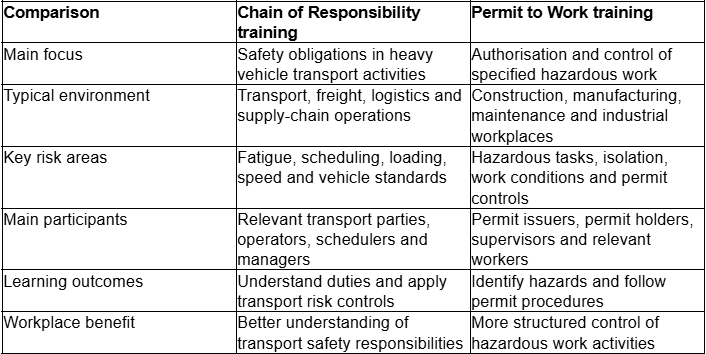
For example, a company operating a warehouse and a heavy vehicle fleet may need to address both transport risks and hazardous maintenance work.
Its transport team may require CoR training to understand the implications of scheduling, fatigue and loading decisions. Maintenance personnel may need permit-to-work training to follow the company's authorisation and isolation procedures.
The courses are complementary rather than interchangeable. Completing one does not automatically satisfy the training or competency requirements associated with the other.
Businesses can gain more value from training by integrating it into everyday operational procedures.
Review transport activities, maintenance tasks, loading processes and other high-risk work. Identify where decisions or procedures could expose workers or the public to harm.
Ensure workers understand their legal duties, assigned responsibilities and authority to report hazards or stop work under applicable procedures.
Provide CoR training to relevant transport personnel and permit-to-work training to employees who need to understand or administer work permits. Identify any additional training or authorisation required for particular tasks.
Maintain suitable transport safety processes, permit forms, risk assessments, isolation procedures and reporting systems. Ensure documents reflect actual workplace conditions.
Workers should have clear channels for reporting unsafe schedules, load restraint concerns, equipment faults, missing controls and other hazards.
Use incidents, near misses, audits and workplace observations to identify recurring problems. Update procedures and training where necessary.
Review whether operational practices meet the applicable legal requirements, industry standards and internal procedures. Training should support these controls, not serve as a substitute for them.
Several mistakes can undermine the effectiveness of transport safety and permit-to-work systems.
Regular review and clear accountability help organisations identify these weaknesses before they contribute to a serious incident.
TLIF0009 covers transport safety obligations, the parties involved in the Chain of Responsibility, reasonable steps, common compliance risks and the application of workplace transport safety procedures.
Permit-to-work training may be relevant to people who issue, receive, work under or supervise permits for hazardous tasks. The appropriate training depends on the person's responsibilities and the workplace's requirements.
Safety Australia Training lists TLIF0009 as a nationally recognised unit of competency. Successful participants who meet the assessment requirements can receive a Statement of Attainment.
The provider's listed program includes MSMWHS201 – Conduct hazard analysis, alongside permit-related units. The course also addresses risk controls and permit procedures.
No. A permit helps establish and document the required controls, but it cannot eliminate every hazard. Work must be assessed, controlled and monitored throughout the task, with changes addressed appropriately.
They may need both, depending on their operations. CoR training can help relevant personnel understand transport safety duties, while permit-to-work training can support the safe management of specified hazardous activities.
Employers should assess job duties, identify applicable legal and workplace requirements, confirm the relevant units of competency and select training that addresses the risks workers actually encounter.
Transport safety and hazardous work management require more than written policies. They depend on informed decisions, clear responsibilities, suitable training and procedures that are consistently followed.
Chain of Responsibility training helps relevant personnel understand their role in maintaining safe transport activities. Permit to Work training supports the structured authorisation and control of hazardous tasks.
By combining appropriate training with practical risk management, effective communication and regular reviews, Australian businesses can strengthen their safety systems and better prepare workers to manage the demands of transport and industrial operations.