
Why Your Brand Needs a Clipping Company That Can Scale

A clipping company that can scale keeps quality, deadlines and reach steady as you grow from a few clips a week to hundreds. The reach part matters more than most brands expect. Platforms treat repeated clips very differently from fresh ones.
As a brand grows, its short-form needs grow fast. A small team can handle a few clips. Ongoing campaigns across several platforms need more editing, more creators and tighter quality control. Working with a clipping company built for that growth means you do not have to build the whole operation in-house.
What works for ten clips a month rarely works for three hundred. More content means more editing, more reviews, more posting and more tracking, all at once.
Without a solid process, extra volume brings delays and uneven results. Your team ends up running content operations instead of marketing. A scalable clipping service takes on that load with one process for production and posting.
More clips mean more edit requests, more feedback and more revisions. Without enough production support, one slow step can push back the whole schedule.
Every clip carries your brand. Once more editors and creators are involved, holding the same standard gets harder. Clear editing rules and a real review step keep it steady.
More creators mean more schedules, more briefs and more changes to pass along. Managing each one yourself can quickly eat your week.
Regular posting builds momentum, and missed deadlines break it. As volume grows, your provider needs enough capacity to keep each batch on schedule.
Scaling is not the same as posting one clip on more accounts. The platforms are clear that repeated content is treated differently.
Instagram says it reduces the distribution of reels "that have already been posted on Instagram." YouTube takes a different route. Its monetization policies cover content that "is repetitive or mass-produced," a July 15, 2025 update to what it used to call "repetitious content." In plain terms, Instagram limits the reach of reposts, and YouTube will not pay channels built on copies.
The lesson is that more volume must also mean more variety. Good scaling looks like this:
Real campaigns show how scale is built from many varied clips, not a few big ones. Lumina Clippers' published case studies list Riverside, in the podcast category, at 7.7M views from 7,982 videos.
Do the math and that is roughly 965 views per video on average. The total came from volume and variety: thousands of distinct clips, each finding its own small audience, rather than one clip going viral. That is the pattern to plan for. If a provider's scaling plan depends on a single clip breaking out, it is a bet, not a plan.
Your volume will change. You might start small, then add source videos, clips or platforms. A scalable provider can explain how it adds editing capacity without dropping quality.
More reach needs more creator accounts, but only well-managed ones. The network should grow in the places your audience actually is.
With many people involved, roles must be clear. One team should manage content, creators, review and posting, so your staff is not juggling dozens of contacts.
At hundreds of clips, manual tracking breaks down. You need reports that show which clips and creators drive results, without your team pulling data from several places.
Review is often the first step to break when volume jumps. A scalable provider adds reviewers as it adds editors, so every clip is still checked against your brief before it posts. Ask how many clips one reviewer handles in a week, and what happens in a busy one.
Growth works best in stages. The table below is an example, not a rule, so adjust it to your goals and your source videos.
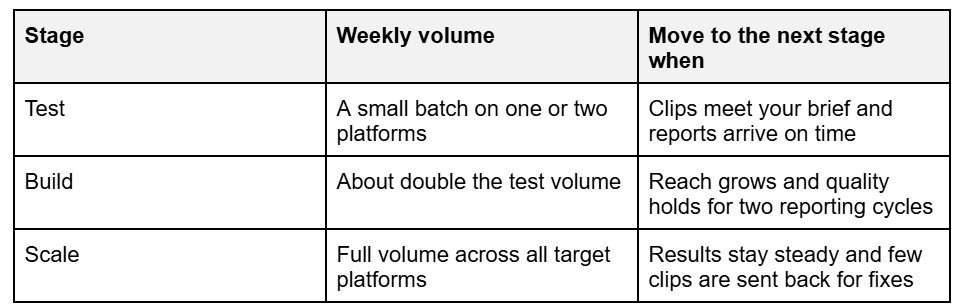
At every stage, keep the creative fresh. If reach drops as volume rises, the first thing to check is whether clips have started to repeat.
If two or more of these sound familiar, your setup is holding back growth.
Decide what growth is for, whether that is awareness, new audiences, product launches or more life for long videos. Goals tell you how much content you need and where it should go.
Do not jump to full volume at once. As an example, double the volume only after two strong reporting cycles. Steps give you and your provider time to fix problems before they multiply.
Review a sample of each batch and track how many clips are sent back for fixes. A rising number is an early warning. Keep a short log of why clips were sent back, too. If the same reason shows up again and again, fix the brief, not just the clip.
More platforms do not automatically mean better results. TikTok, Instagram Reels, YouTube Shorts and X each suit different content and audiences. Start where your buyers already spend time. Add a new platform only when the first ones run smoothly and you have enough fresh edits to feed it.
It means adding volume, creators and platforms while keeping quality, deadlines and reporting steady.
It can if the clips repeat. Instagram says it cuts the reach of reels that were already posted. YouTube will not pay channels for repetitive or mass-produced content. So scale with new edits, not copies.
In steps. Grow volume after strong results, and check quality in every batch before the next increase.
The goal is not simply more clips. It is a content process that can grow with your brand without losing quality or reach. Choose a partner with the capacity, creators, review process and reporting to grow in steps. Then make sure it has the creative range to keep every batch fresh.